Zaru soba is a cold Japanese buckwheat noodle dish served with a dipping sauce called tsuyu, traditionally presented on a bamboo strainer. I make mine with smoked salmon instead of the usual raw sashimi.
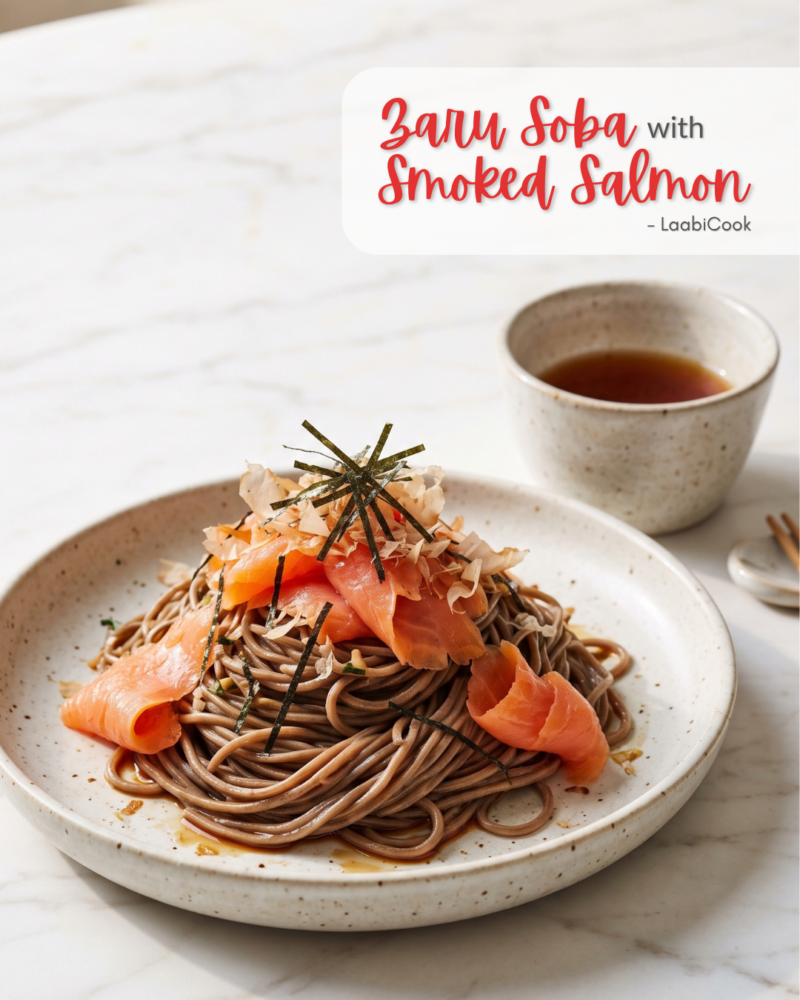
This is my go-to zaru soba recipe for nights when I want something clean and cooling. Only 10 ingredients. No stove time beyond boiling water. The whole thing comes together in 20 minutes flat.
Why You’ll Love This Recipe
- No raw fish handling: Smoked salmon gives you that silky, savory protein without the stress of sourcing sushi-grade fish or timing a marinade.
- True cold noodle technique: The shock of ice-cold water on the soba gives you that signature springy bite that defines proper zaru soba.
- Make-ahead friendly: The dipping sauce keeps for a week in the fridge, so you can have this ready in the time it takes to boil water.
The Culinary Secrets Behind This Dish
The double-boil method for dried soba is not fussy tradition; it is starch control. Buckwheat flour has no gluten to hold it together, so the surface gelatinises fast in boiling water and turns gummy. Adding that second cup of cold water drops the temperature, arrests the surface cooking, and lets the center catch up without the exterior collapsing. This is how you get noodles that cling to your chopsticks instead of clumping in the bowl.
The dipping sauce relies on a brief steep, not a long simmer. Bonito flakes are full of umami-rich amino acids and nucleotides that extract quickly in hot liquid; five minutes is enough to pull their savor without the bitterness that comes from over-extraction. The residual heat also mellows the grated ginger just enough to take off its raw edge while keeping its aromatic bite. Straining matters here: you want a clear, glossy liquid that coats the noodles without depositing gritty flakes.
What You’ll Need
Equipment
- Medium pot: You need room for the soba to swim freely; crowding causes the noodles to stick and cook unevenly.
- Small pot: For the dipping sauce, so you can bring it to a quick boil and pull it off the heat precisely.
- Fine-mesh strainer: To catch the bonito flakes and ginger, leaving you with a smooth tsuyu that looks as good as it tastes.
- Serving bowls: Small ones for the dipping sauce; the noodles themselves can go on any plate or traditional zaru basket if you have one.
Ingredients
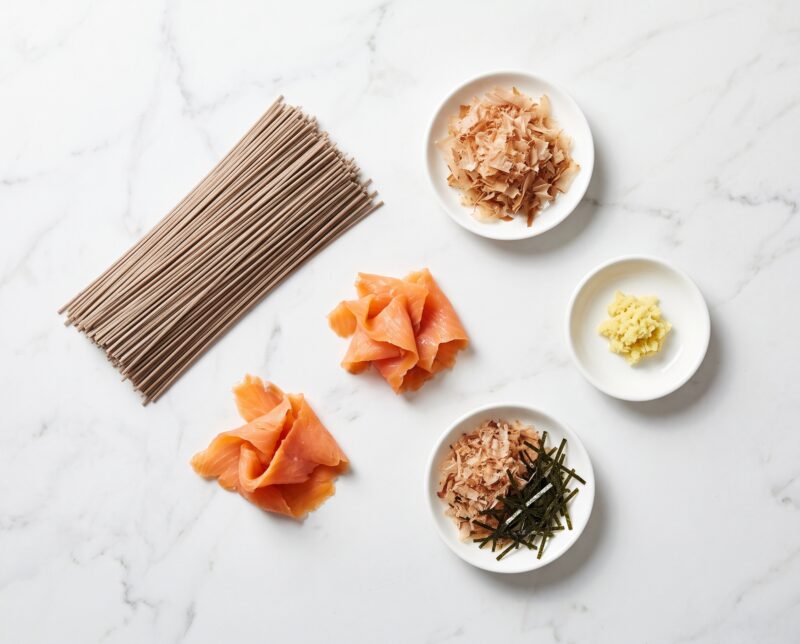
- Soba noodles, 300g: Buckwheat gives that nutty, slightly earthy backbone; look for those with a high buckwheat percentage for better texture.
Dipping Sauce (Tsuyu)
- Water, 2 cups: The base that carries all the other flavors; filtered water tastes cleaner in a cold dish like this.
- Mirin, 3 tablespoons: Sweet Japanese cooking wine that rounds the saltiness and gives the sauce its characteristic gloss.
- Soy sauce, 2 tablespoons: The savory anchor; use a Japanese-style shoyu if you have it for more depth, less sharpness.
- Sugar, ½ tablespoon: Balances the salt and the alcohol heat from the mirin; plain white sugar dissolves cleanest.
- Salt, 1 teaspoon: Fine-tunes the seasoning; you may not need the full amount depending on your soy sauce.
- Bonito flakes, 2 tablespoons: Dried fermented skipjack tuna that delivers serious umami; do not skip if you want real flavor.
- Ginger, 1 teaspoon grated: Cuts through the richness of the salmon and wakes up the palate with gentle heat.
Toppings
- Smoked salmon, 50g: Silky, savory, and already cooked; I buy the sliced packs from the supermarket cold case.
- Bonito flakes, for garnish: A light scattering on top adds movement and reinforces that smoky, savory note.
- Nori strips, for garnish: Toasted seaweed brings a whisper of the sea and a crisp texture contrast.
Step-by-Step Cooking Guide
1: Boil the dried soba
- If using dried noodles, drop them into a pot of boiling water and stir slowly to separate. The water should cover them by a few inches.
2: Add cold water and finish
- When the water returns to a boil, pour in 1 cup of cold water. Let it come back to a boil and cook until the noodles yield to the teeth but still have a definite spring, usually 4-5 minutes total depending on brand. Taste one; it should not be crunchy, but it should fight back slightly.
3: Shock and rinse
- Drain immediately and rinse under cold running water, rubbing gently with your hands to wash off surface starch. This is what gives zaru soba its signature slippery, refreshing finish. Keep rinsing until the water running off is no longer cloudy.
4: Or heat ready-cooked soba
- If your soba is pre-cooked, simply bring a pot of water to a boil, drop the noodles in for 2 minutes to loosen and warm through, then drain and rinse cold.
5: Set noodles aside
- Let them drain completely while you make the sauce; any excess water will dilute your tsuyu.
6: Build the dipping sauce
- In a small pot, combine the water, mirin, soy sauce, sugar, and salt. Bring to a full boil, stirring once to dissolve the sugar.
7: Steep the aromatics
- Add the bonito flakes and grated ginger, then remove from heat immediately. Let it sit for exactly 5 minutes; the liquid will turn a pale amber and smell deeply savory.
8: Strain the tsuyu
- Pour through a fine strainer into small serving bowls, pressing gently on the solids to extract the last of the flavor. Discard the spent flakes.
9: Assemble the bowls
- Pile the cold soba onto plates or into shallow bowls. Drape the smoked salmon over the top in loose folds.
10: Garnish and serve
- Scatter a pinch of bonito flakes and a few strips of nori over everything. Place the dipping sauce alongside, not poured over. Eat by picking up a bundle of noodles with chopsticks, dipping lightly into the tsuyu, and slurping with gusto. This is the best part!
Ingredient Substitutions & Variations
| Ingredient | Substitute | Taste & Texture Impact |
| Soba noodles | Somen or udon | Somen is closer in delicacy but lacks buckwheat’s nuttiness; udon is too heavy and chewy for this preparation. Both work in a pinch, but it is not really zaru soba anymore. |
| Mirin | 2 tablespoons sake plus 1 tablespoon sugar | You lose some of that glossy mouthfeel and subtle complexity; the sauce will taste slightly sharper and less rounded. |
| Bonito flakes | Dried shiitake soaking liquid or vegetarian dashi | You lose the smoky, fermented depth entirely. The result is still pleasant but one-dimensional; I would not serve this to anyone who knows real zaru soba. |
| Smoked salmon | Cooked shrimp or tamagoyaki | Shrimp keeps the protein light and oceanic; tamagoyaki (sweet omelet) makes it more like a soba salad. Both are traditional enough. |
Recipe twists:
| Variation | Description & Culinary Details |
| Zaru Soba with Tempura | Add a few pieces of cold or room-temperature vegetable tempura on the side; the sauce works for dipping both noodles and crisp fried vegetables. |
| Spicy Yuzu Zaru Soba | Stir a teaspoon of yuzu kosho into the dipping sauce for a bright, spicy citrus kick that cuts through the smoke of the salmon. |
Allergen Friendly Adjustments
- Gluten-Free: Soba is made from buckwheat, which is naturally gluten-free, but many brands add wheat flour for elasticity; check the label for 100% soba or juwari soba if you need this to be truly gluten-free.
- Dairy-Free: This recipe contains no dairy products as written.
- Nut-Free: No tree nuts or peanuts are used, though always check your soy sauce and mirin labels for cross-contamination warnings if you are highly sensitive.
- Fish-Free: Bonito flakes and smoked salmon both contain fish; substitute dried shiitake and cooked mushrooms or tofu to make this pescatarian or vegetarian, though the flavor profile will shift significantly.
Serving and Pairing Suggestions
- Beverage pairing: Cold genmaicha or a light, dry sake; the toasty rice notes in the tea echo the buckwheat, and sake’s clean acidity handles the smoked fish beautifully.
- Side dish: A small bowl of Japanese cold tofu with ginger and scallion, keeps the meal light and cooling.
- Another side: Quick-pickled cucumber with rice vinegar and a pinch of sugar adds crunch and acidity to reset your palate between bites.
Storage, Reheating, and Freezing Guide
- Refrigeration: The dipping sauce keeps in a sealed jar for up to 7 days; the noodles are best eaten immediately but can be stored separately, tossed with a drop of oil, for 1 day.
- Reheating: This is a cold noodle dish; if you must warm leftover soba, a quick dip in boiling water for 30 seconds will refresh it, though the texture will never be quite the same.
- Freezing: Freezing is not recommended; the noodles turn brittle and the sauce separates upon thawing.
Frequently Asked Questions (FAQ)
▶ Why does my soba always turn gummy?
You are probably skipping the cold water step or not rinsing aggressively enough. Surface starch is the enemy; that second addition of cold water and thorough hand-rinsing under running water are non-negotiable.
▶ Can I use the dipping sauce hot instead?
You can, but then you are making kake soba, not zaru soba. The cold sauce against cold noodles is the whole point of this dish; it is what makes it so refreshing on a hot day.
▶ My mother always added wasabi to the dipping sauce. Is that wrong?
Not wrong at all; many people do this. Stir a little wasabi paste into your individual bowl of tsuyu before dipping. It adds heat and is especially good with the smoked salmon.
▶ Where do I find bonito flakes?
Any Japanese or Korean grocery store stocks them; look for katsuobushi in small pink or silver packets in the dried goods aisle. They keep forever in the pantry and also make great furikake for rice.
Zaru Soba with Smoked Salmon
Equipment
- Pot
- serving bowls
Ingredients
- 300 g soba noodles
- 2 cups water
- 3 tbsps mirin
- 2 tbsps soy sauce
- ½ tbsp sugar
- 1 tsp salt
- 2 tbsps bonito flakes
- 1 tsp grated ginger
- 50 g smoked salmon
- bonito flakes and strips of Japanese seaweed (nori) , for garnishing
Instructions
- If using dried soba noodles, place noodles in a pot of boiling water to cover and stir slowly to prevent them from sticking together. Bring water to a boil again and add 1 cup of water. Boil noodles till they become soft enough, yet still have bite. Drain and rinse noodles under cold water.
- If using ready-cooked soba, bring a pot of water to boil, and heat soba for about 2 mins. Drain noodles and rinse under cold water. Set aside.
- To make dipping sauce, place water, mirin, soy sauce, sugar and salt in a small pot; bring to boil. Add bonito flakes and grated ginger. Remove from fire and set aside for 5 mins.
- Strain mixture into small serving bowls.
- To assemble, top soba noodles with smoked salmon slices, and garnish with bonito flakes and seaweed. Serve with a bowl of dipping sauce on the side.
Gobble these up too!
-

Only laksa paste, tuna and spaghetti stand between you and dinner. I make this when… Cook recipe >
-
Crispy bacon, sweet capsicum, and juicy tomatoes tossed with macaroni in olive oil. Only 8… Cook recipe >
-
Sambal belacan transforms everyday beef and noodles into something you will want to make weekly.… Cook recipe >
-
Blend that century egg yolk into a velvety sesame sauce, toss with hot noodles, and… Cook recipe >