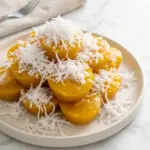
Thai pumpkin kuih is a steamed coconut cake from Thailand made with mashed pumpkin, coconut milk, and a blend of rice and tapioca flours. You find it at morning markets across the country, sold from stacked aluminum trays wrapped in banana leaves, still warm from the steamer.

This Thai pumpkin kuih recipe uses only eight ingredients and a basic steamer. It is fast, cheap, and keeps well. My family asks for it when the weather turns cool, and I make a batch on Sunday to last the week. The texture is the thing: soft, slightly sweet, with that pull-apart chew you cannot get from baked cakes.
Why You’ll Love This Recipe
- Only one cooking vessel: Everything mixes in a single bowl and steams in one batch. Cleanup is minimal, which matters on a busy morning.
- Chewy, not crumbly: The rice flour and tapioca flour combination gives a texture you cannot get from wheat flour cakes. It is bouncy, tender, and satisfyingly dense.
- Naturally gluten-free: No specialty flours needed beyond what any Asian pantry already stocks. It is accidentally inclusive for gluten-free guests.
The Culinary Secrets Behind This Dish
The chewy, bouncy texture of kuih comes from the partnership between rice flour and tapioca flour. Rice flour provides structure and a clean, slightly firm bite, while tapioca flour brings stretch and that signature springiness you feel when you pull a piece apart. Together they create a texture neither starch achieves alone. Steaming rather than baking matters too. Steam keeps the mixture hydrated and prevents the surface from drying into a crust, which would ruin the tender skin that defines good kuih.
Pumpkin does more than flavor here. Its high water content and fine, silky fiber bulk the batter without making it heavy, and its natural sugars mean you can use less refined sugar than in plain coconut kuih. The egg yellow coloring is traditional in Southeast Asian kitchens where pumpkin alone might not give the vivid golden hue expected at the table, but it also signals something useful to the cook: when the surface turns uniformly sunny and set, the center has likely cooked through.
What You’ll Need
Equipment
- Masher: You need this to break steamed pumpkin into a smooth, lump-free puree before it meets the flours. A fork works in a pinch but takes longer.
- Mixing bowl: A large one lets you fold the batter without spilling. The mixture is thick and sticky, so room to work matters.
- Muffin moulds: Small greased moulds give each kuih its domed shape and even thickness, which means even steaming and consistent texture throughout.
- Steamer: Essential for the cooking method. A wok with a rack and lid, or a stacked steamer pot, both work. You need enough clearance for the moulds to sit above boiling water.
Ingredients

Batter
- Pumpkin, 500 g: Peeled, cubed, and steamed until soft. This is the backbone of the batter, giving moisture, gentle sweetness, and that warm orange color.
- Thick coconut milk or coconut cream, 125 ml: Adds richness and fat that carries flavor through the steamed cake. Do not use thin coconut milk; the kuih will taste watery.
- Grated coconut, 100 g: White part only. Mixed into the batter for texture and true coconut flavor throughout, not just on top.
- Rice flour, 75 g: The structural base. It sets firm when steamed, giving the kuih its slice-able, clean-edged crumb.
- Tapioca flour, 30 g: The secret to bounce and chew. Without it, your kuih will be soft but never properly springy.
- Salt, 1/4 tsp: A small amount to sharpen the sweetness and prevent the coconut from tasting flat.
- Caster sugar, 100 g: Fine sugar dissolves easily into the wet batter. You can reduce slightly if your pumpkin is especially sweet.
- Egg yellow colouring, 1/2 tsp: Traditional for the vivid golden color of market kuih. Optional if you prefer to keep things natural, though the result will be paler.
To Garnish
- Grated coconut, 50 g extra: For garnish. Pressed onto the steamed surface, it adds fresh contrast and that fragrant first bite.
Step-by-Step Cooking Guide
1: Mash the pumpkin
- Steam your peeled and cubed pumpkin until completely soft, about 15-20 minutes depending on cube size. A knife should slide through with no resistance. Transfer to a bowl and mash until perfectly smooth, working out every lump. This puree is the foundation of your batter; any fibrous bits will show in the finished kuih.
2: Mix the batter
- In a large mixing bowl, combine the pumpkin puree, coconut milk, half of the grated coconut, rice flour, tapioca flour, salt, sugar, and egg yellow colouring. Stir thoroughly until you have a thick, uniform batter with no streaks of white flour or yellow color. The mixture should be stiff enough to hold its shape when spooned.
3: Fill, top, and steam
- Lightly grease your muffin moulds, then spoon the batter in, filling each about two-thirds full. Sprinkle the remaining grated coconut evenly over the tops. Arrange in your steamer, cover, and steam over rapidly boiling water for 20 to 30 minutes. The kuih are done when the surface is set, slightly springy to touch, and no longer wet or shiny in the center.
4: Cool and unmould
- Remove from heat and let the moulds sit for 5 minutes. The kuih will pull away from the sides slightly as they cool, making unmoulding easier. Turn out onto a plate and top with extra grated coconut if you like. Serve warm or at room temperature.
Ingredient Substitutions & Variations
| Ingredient | Substitute | Taste & Texture Impact |
| Pumpkin | Butternut squash | Minimal. Butternut gives a finer, less fibrous texture and slightly more sweetness. |
| Egg yellow colouring | A few drops yellow food coloring, or a pinch turmeric | Minimal if using liquid food coloring. Turmeric powder will add a faint earthy note; use only 1/8 tsp to avoid bitterness. |
Recipe twists:
| Variation | Description & Culinary Details |
| Sweet potato kuih | Replace pumpkin with mashed steamed sweet potato. Use purple or orange varieties. Reduce sugar by 20 g as sweet potato is naturally sweeter. The texture remains similar but the flavor is earthier. |
| Pandan coconut kuih | Add 1/2 tsp pandan paste or 3-4 drops pandan essence to the batter, and fold in a few extra tablespoons of grated coconut. This gives the classic Southeast Asian fragrance and a pale green color. |
| Palm sugar kuih | Fold 50 g of palm sugar, gently melted with 1 tablespoon water and cooled, into the batter instead of caster sugar. The deeper, caramel notes suit the pumpkin beautifully and give a more traditional Thai sweetness. |
Allergen Friendly Adjustments
- Gluten-Free: This recipe is already gluten-free. Rice flour and tapioca flour contain no wheat gluten.
- Dairy-Free: This recipe is already dairy-free. Coconut milk replaces any need for cow’s milk or butter.
- Nut-Free: This recipe is already nut-free. Coconut is botanically a fruit, not a tree nut, though some with coconut sensitivity should note its presence.
Serving and Pairing Suggestions
- Thai iced tea: The strong black tea and condensed milk cut through the coconut richness and match the Thai origin of the kuih.
- Fresh tropical fruit: Mango, jackfruit, or longan on the side adds acidity and freshness to balance the dense, starchy cake.
- Kopi O: A dark, unsweetened Malaysian-style coffee works for breakfast or afternoon, letting the kuih’s gentle sweetness come forward.
Storage, Reheating, and Freezing Guide
- Refrigeration: Store in an airtight container for up to 3 days. The texture firms in the cold; let sit at room temperature 15 minutes before eating, or reheat briefly.
- Freezing: Not recommended. The grated coconut garnish turns stale and the steamed texture becomes rubbery after thawing. Make a fresh batch; it is quick enough.
- Reheating: Steam for 5 minutes to restore softness, or microwave 20-30 seconds. Do not overheat or the kuih will dry and toughen.
Frequently Asked Questions (FAQ)
▶ Can I replace tapioca flour with more rice flour?
Yes, but the texture will be heavier and less springy. Tapioca flour is what gives kuih its characteristic chew. If you must substitute, use an equal weight of glutinous rice flour; the result will be sticky rather than bouncy, but still pleasant.
▶ Why did my kuih turn out dense and wet in the middle?
Usually because the steamer temperature dropped too low, or the moulds were overfilled. Make sure your water is at a rolling boil before you start, and fill moulds only two-thirds full so heat circulates evenly over the surface.
▶ Can I use desiccated coconut instead of fresh grated coconut?
Freshly grated coconut from the wet market or frozen section is best. Desiccated coconut from baking aisles is too dry and will not adhere properly. If frozen, thaw completely and squeeze out excess liquid before using.
Thai-Style Pumpkin Kuih
Equipment
- masher
- Mixing Bowl
- muffin moulds
- Steamer
Ingredients
- 500 g pumpkin , peeled, cubed and steamed until soft
- 125 ml thick coconut milk or coconut cream
- 100 g grated coconut , use white part only
- 75 g rice flour
- 30 g tapioca flour
- ¼ tsp salt
- 100 g caster sugar
- ½ tsp egg yellow colouring
- 50 g grated coconut , extra, to garnish
Instructions
- Mash steamed pumpkin until smooth.
- Put pumpkin, coconut milk, half of grated coconut, rice flour, tapioca flour, salt, sugar and colouring into a mixing bowl. Stir to mix.
- Spoon mixture into small greased muffin moulds. Sprinkle remaining coconut over. Steam for 20 to 30 mins or until set.
- Allow to cool for 5 mins. Unmould and serve topped with extra grated coconut.
Gobble these up too!
-

Light chamomile tea meets sweet lychee in this wobbly Konniyaku jelly. Set it in the… Cook recipe >
-
No gelatin, no fuss, no baking. This rose agar agar uses just 5 ingredients and… Cook recipe >
-
There is nothing quite as comforting as opening a bamboo steamer to reveal a batch… Cook recipe >