Few dishes deliver the dramatic flavor return for minimal kitchen time quite like a classic Southeast Asian seafood curry. This Thai Red Curry with Fish and Prawns balances speed, aromatic complexity, and luxurious textures into a single wok dish ready in 15 minutes of active cooking time. By pairing firm white fish with juicy, tail-on prawns, you get a varied protein texture enveloped in a rich, spicy coconut emulsion.

The foundation of this speed-focused recipe rests on blooming concentrated Thai curry paste in hot oil alongside sliced shallots. This quick step releases essential fat-soluble aromatics including lemongrass, galangal, and dried red chillies. Adding velvety coconut milk creates a luscious broth that gently poaches delicate seafood without toughing or drying out the proteins.
Whether you are seeking a fast weeknight dinner or an impressive dish for guests, this seafood curry satisfies all cravings. Finished with a squeeze of fresh lime juice, umami-rich fish sauce, and bright coriander leaves, each bowl delivers a balance of salty, sweet, sour, and spicy notes served over steaming white rice.
Why You’ll Love This Recipe
- Lightning Fast Execution: Requires only 15 minutes of stove-top cooking time, making it ideal for busy weeknights.
- Restaurant-Quality Depth: Blooming curry paste in warm lipid oil releases complex flavor compounds for maximum taste.
- Perfect Seafood Poaching: Gentle simmering ensures succulent prawns and tender, non-flaky fish in every bite.
The Culinary Secrets Behind This Dish
To understand why this dish tastes so extraordinary, we can look at the culinary science happening behind the recipe.
The key to mastering rapid curry recipes lies in understanding temperature control and lipid blooming. Thai red curry paste consists of ground herbs and roots whose aromatic essential oils are fat-soluble. Frying the paste directly in hot peanut oil and softened shallots for two minutes triggers rapid flavor extraction, amplifying capsaicin and aromatic terpenes far better than boiling the paste directly in liquid.
Seafood requires gentle thermal handling. Both white fish (such as snapper) and medium prawns coagulate their proteins rapidly around 60 to 65 degrees Celsius. Submerging seafood into a boiling curry liquid causes muscle fibers to contract violently, squeezing out moisture and leaving prawns rubbery and fish dry. Maintaining a low, steady simmer (uncovered) cooks the seafood gently via conductive heat transfer within five minutes. Finally, adding fresh citrus juice and fish sauce right at the end protects delicate volatile acids from breaking down, ensuring a vibrant flavor profile.
What You’ll Need
Equipment
- Wok or Deep Skillet: A standard 12-inch or 14-inch carbon steel wok or heavy-bottomed deep skillet for even heat distribution.
- Wooden Spoon or Silicone Spatula: Ideal for stirring shallots and gently turning fish without breaking delicate fillets.
- Chef’s Knife and Cutting Board: For thin precision slicing of shallots, fresh chillies, and portioning fish into uniform 4-cm pieces.
Ingredients
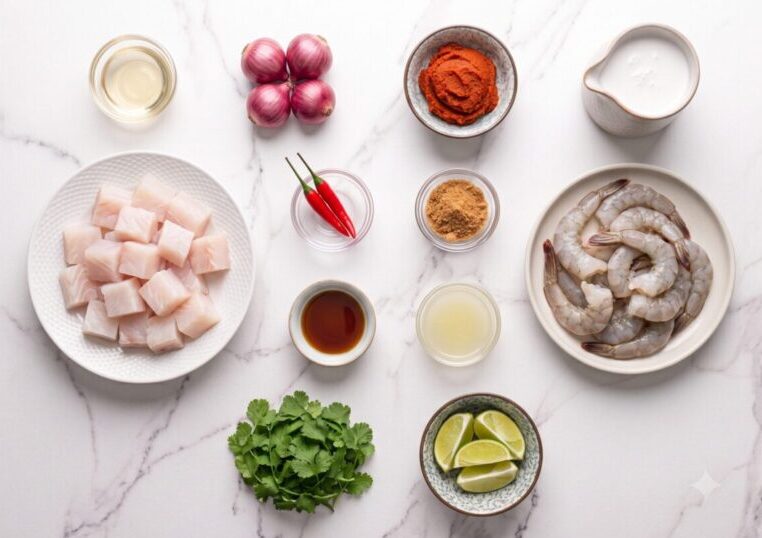
- Peanut oil (1 tbsp): Groundnut oil provides a subtle, nutty backbone that enhances aromatic frying without scorching spice solids.
- Shallots (4 whole): Sliced thinly across the grain. Shallots offer higher sugar content than onions, caramelizing quickly to provide a sweet aromatic baseline.
- Red Thai curry paste (75 g): A concentrated blend containing dried chilies, galangal, kaffir lime, lemongrass, and garlic.
- Coconut milk (425 g): High lipid emulsion that tempers spice, adds richness, and serves as a gentle poaching medium.
- Red or green chillies (2 whole): Thinly sliced. Adds fresh herbaceous heat, capsaicin pop, and vibrant visual contrast.
- Firm white fish fillets (500 g): Snapper, threadfin, or cod. Cut into clean 4-cm cubes.Medium collagen structure preserves fillet integrity during gentle simmering.
- Medium prawns (750 g): Shelled and deveined, leaving tails intact for elegant presentation and rich gelatin release.
- Fish sauce (2 tbsp): Provides vital savory umami depth, sodium balance, and complex fermented notes.
- Lime juice (2 tbsp): Delivers sharp citric acid to cut through rich coconut fats and brighten the overall broth.
- Brown sugar (1 tbsp): Softens harsh chili capsaicin and balances fish sauce saltiness.
- Fresh coriander leaves (1/2 cup): Loosely packed fresh leaves added right before serving for a burst of fresh citrusy herbal notes.
Step-by-Step Cooking Guide
1: Sauté Aromatic Shallots
- Place your wok or heavy deep skillet over medium heat and add 1 tablespoon of peanut oil. Once the oil shimmers, add the thinly sliced shallots. Cook for 2 to 3 minutes, stirring continuously, until they turn translucent, soft, and fragrant.
2: Bloom Curry Paste & Reduce Coconut Milk
- Add 75 g of red Thai curry paste to the wok. Cook and stir for about 2 minutes until the oil begins to separate slightly and aromatics fill the air. Pour in the 425 g of coconut milk and add the sliced chillies. Reduce heat to low-medium and simmer uncovered for 5 minutes until the curry sauce thickens slightly.
3: Poach Fish Fillets and Prawns
- Gently add the 4-cm snapper or threadfin pieces along with the shelled, deveined prawns into the simmering curry sauce. Submerge the seafood into the liquid. Simmer uncovered over gentle low heat for approximately 5 minutes, turning pieces once, until the fish flakes easily and prawns turn opaque and pink.
4: Balance Flavors and Serve
- Stir in 2 tablespoons of fish sauce, 2 tablespoons of freshly squeezed lime juice, and 1 tablespoon of brown sugar. Taste and adjust seasoning if needed. Scatter fresh coriander leaves over top and serve immediately with hot jasmine or white rice.
Ingredient Substitutions & Variations
Cooking should be adaptable! If you’re missing a few items, here is how you can easily swap them out while keeping the same incredible flavor profile:
| Ingredient | Substitute | Taste & Texture Impact |
| Snapper or Threadfin Fillets | Barramundi, Cod, Halibut, or Sea Bass | Any firm white fish that holds its shape during gentle poaching works wonderfully in this curry. |
| Peanut Oil | Canola Oil, Vegetable Oil, or Coconut Oil | Neutral cooking oils with high smoke points maintain pure curry flavors without burning. |
| Brown Sugar | Palm Sugar or Coconut Sugar | Palm sugar offers traditional caramel notes that melt seamlessly into warm coconut curry. |
Recipe twists:
| Variation | Description & Culinary Details |
| Vegetable-Loaded Seafood Curry | Add baby corn, sliced bamboo shoots, and snow peas along with the coconut milk in Step 2 for added crunch and dietary fiber. |
| Thai Green Curry Twist | Swap red curry paste for authentic green curry paste and top with fresh Thai basil leaves instead of coriander for an herbaceous flavor profile. |
Allergen Friendly Adjustments
- Gluten-Free: Ensure your commercial Thai red curry paste and fish sauce are certified gluten-free, as some processing facilities use wheat additives.
- Dairy-Free: This recipe is naturally 100% dairy-free thanks to the rich canned coconut milk base.
- Nut-Free: Replace peanut oil with neutral canola oil, sunflower oil, or vegetable oil to render the dish entirely nut-free.
Serving and Pairing Suggestions
- Ladle hot seafood curry generously into shallow wide bowls over a mound of steamed Thai jasmine rice. Garnish with additional fresh coriander sprigs, extra fresh chili slices, and a quartered lime wedge for an inviting presentation.
- Beverage: An off-dry Riesling or Gewürztraminer with subtle residual sweetness offsets chili heat while complementing rich coconut broth.
- Side Dish: A crisp Thai cucumber salad tossed in light rice vinegar dressing provides a cool, refreshing textural counterpoint.
Storage, Reheating, and Freezing Guide
- Refrigeration: Transfer leftover curry to an airtight container within one hour of cooking. Store in the refrigerator for up to 2 days maximum due to delicate seafood proteins.
- Freezing: Freezing is not recommended for cooked seafood curries. Freezing compromises prawn texture, causes fish to become grainy, and leads coconut emulsions to split upon thawing.
- Reheating: Reheat gently in a small saucepan over low heat on the stove-top until warm throughout (around 2 to 3 minutes). Avoid microwave heating as it overcooks prawns into rubbery textures.
Frequently Asked Questions (FAQ)
▶ Can I prepare this seafood red curry ahead of time?
You can slice aromatics and prep seafood hours in advance. However, actual cooking should occur right before serving to maintain succulent seafood texture.
▶ What can I do if my red curry sauce turns out too spicy?
Stir in an additional two to three tablespoons of coconut milk or coconut cream, or increase brown sugar by one teaspoon to tame capsaicin heat.
▶ How do I keep my white fish from flaking apart during cooking?
Choose firm-fleshed white fish options like snapper, barramundi, or cod. Cut into substantial 4-cm cubes and stir gently using a silicone spatula.
▶ Why is it important to add lime juice right at the end?
Simmering fresh citrus juice over high heat dulls bright acid notes and can cause high-fat coconut milk to split or curdle.

Thai Fish and Prawns Red Curry
Equipment
- Wok or Deep Skillet A standard 12-inch or 14-inch carbon steel wok or heavy-bottomed deep skillet for even heat distribution.
- Wooden Spoon or Silicone Spatula Ideal for stirring shallots and gently turning fish without breaking delicate fillets.
- Chef's Knife and Cutting Board For thin precision slicing of shallots, fresh chillies, and portioning fish into uniform 4-cm pieces.
Ingredients
- 1 tbsp peanut oil
- 4 shallots , sliced thinly
- 75 g red Thai curry paste
- 425 g coconut milk
- 2 red or green chillies , sliced thinly
- 500 g firm white fish fillets (snapper or threadfin) , cut into 4-cm pieces
- 750 g medium prawns , shelled leaving tails intact and deveined
- 2 tbsps fish sauce
- 2 tbsps lime juice
- 1 tbsp brown sugar
- 1/2 cup fresh coriander leaves
Instructions
- Heat oil in a wok over medium fire. When hot, add shallots, cook, stirring until soft.
- Add curry paste, cook, stirring until fragrant, about 2 mins. Add coconut milk and chillies. Lower fire and simmer, uncovered, for about 5 mins or until mixture thickens slightly.
- Add fish and prawns to wok. Simmer, uncovered, until fish and prawns are just cooked through, about 5 mins.
- Stir in fish sauce, lime juice and brown sugar, sprinkle fresh coriander leaves over. Serve with hot white rice.
Gobble these up too!
-

My dad used to come home with too much sotong. This 15-minute squid stew is…
-
This chickpea, pumpkin and eggplant curry simmers into something truly comforting. Serve it over rice…
-
Few dishes deliver the dramatic flavor return for minimal kitchen time quite like a classic…
-
This stir-fried lemongrass pork in chilled lettuce cups captures that balance with effortless elegance. Minced…